Capstone: make a defensible handover decision
Integrate the plan, requirements, risks and evidence.
2.0 minutes · English captions · Transcript + illustrated learning notes
This lesson has required companion reading below, including material not spoken in the video. Complete it before the assessment.
English captions available in the video player.
Narration and visual explanations
This transcript represents the recorded lesson using conventional written abbreviations and numerals. Open View technical information to see each diagram and its explanation. This lesson has required companion reading below, including material not spoken in the video. Complete it before the assessment.
The review packet
View technical information · Diagram 1
Lesson explanation
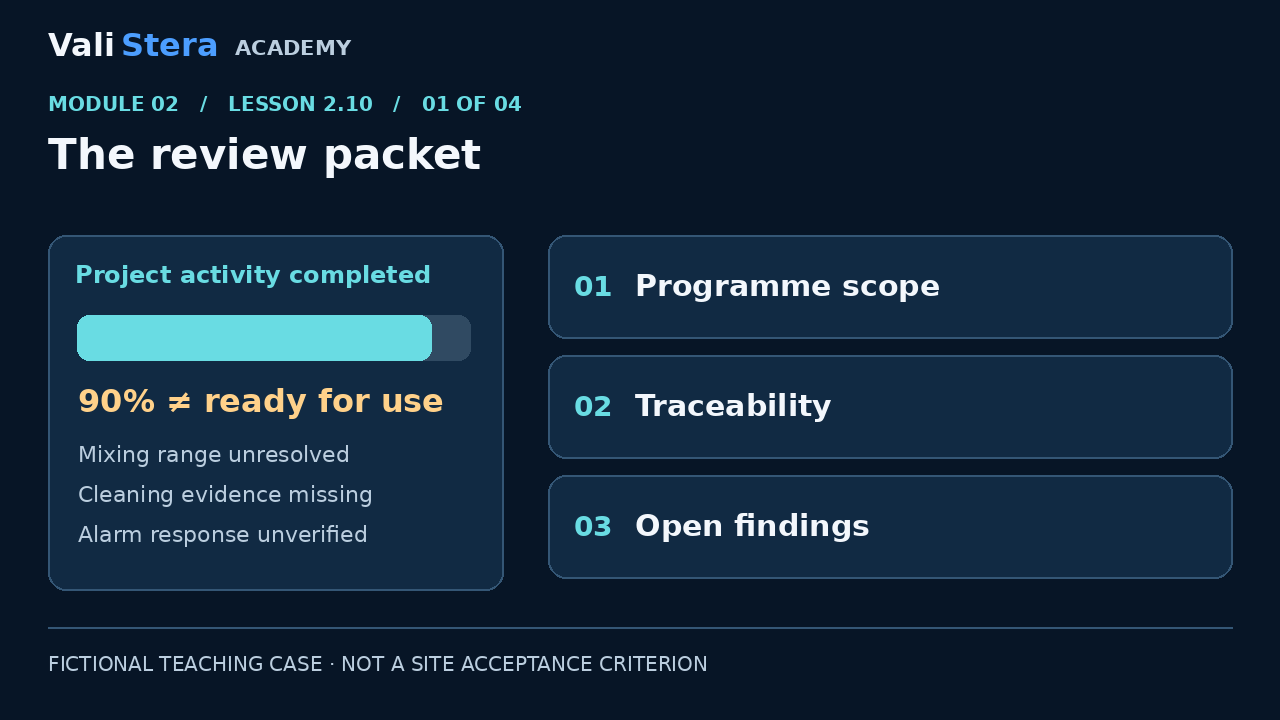
You are reviewing the fictional V-201 handover. The intended use is documented and the material records are available. However, the required mixing range has not been finalized, the transfer-hose cleaning evidence is missing and the alarm response has not been verified. A dashboard says 90% complete. Your task is to decide what the evidence supports, not to maximize the completion percentage.
Separate project progress from readiness
View technical information · Diagram 2
Lesson explanation
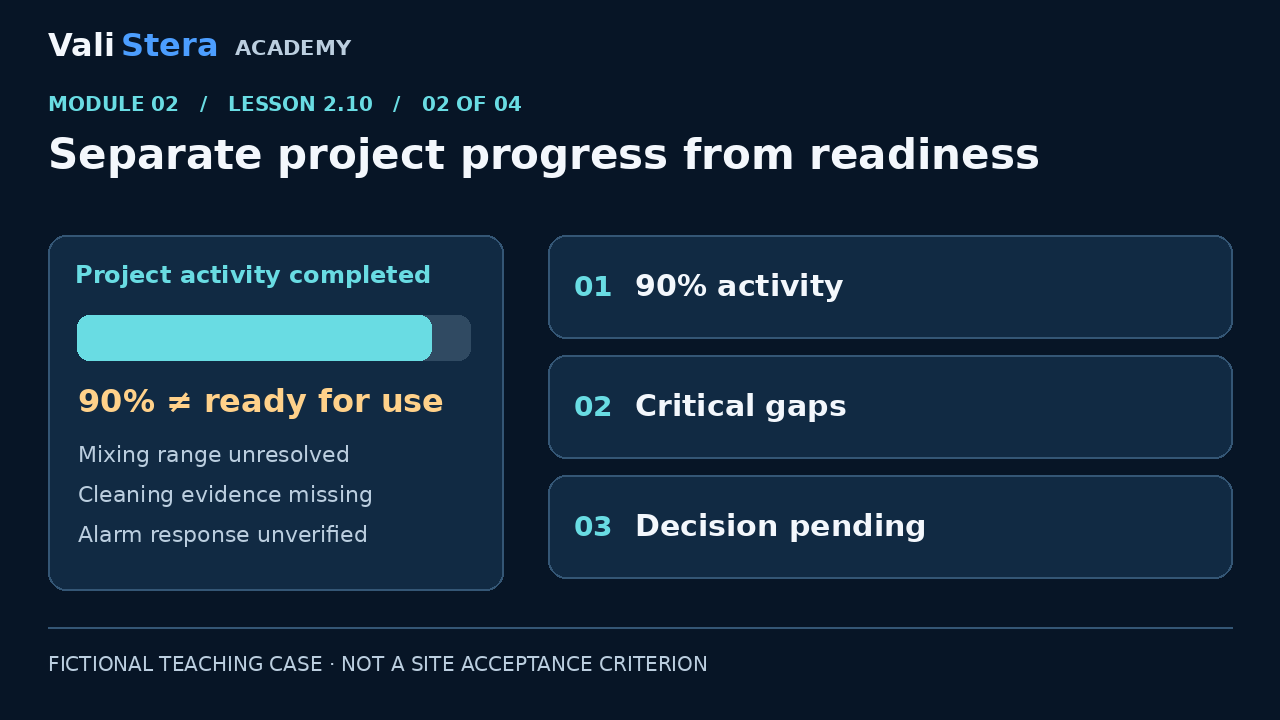
A percentage can be useful for scheduling, but it treats unlike activities as if they were interchangeable. Finishing several minor tasks does not offset an unresolved requirement that affects product quality. The visual compares a large completion bar with three named gaps. Read the gaps directly: mixing range, cleaning evidence and alarm response. Their significance must be evaluated individually in the context of the intended use.
Write a reasoned decision
View technical information · Diagram 3
Lesson explanation
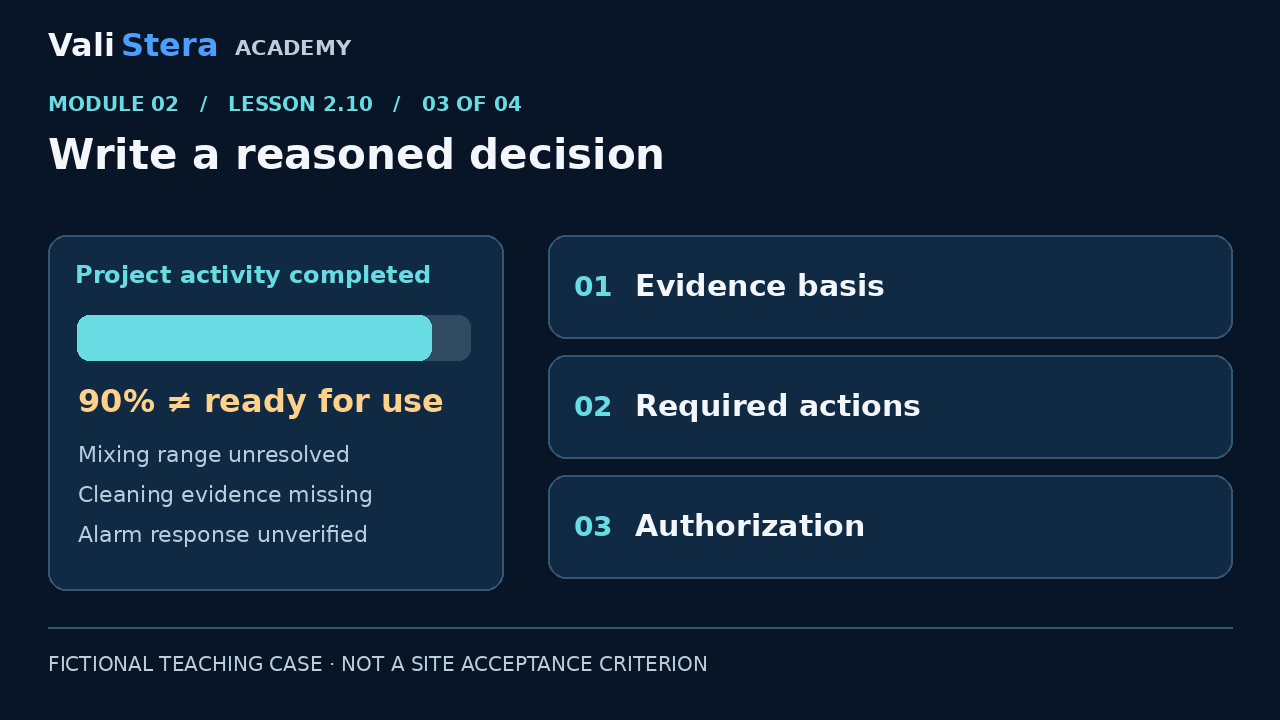
For this exercise, routine-use readiness is not demonstrated. State that conclusion, identify the missing evidence, assign owners and define what must be reviewed before a new decision. If a project proposes progression to a limited next stage, assess that specific activity and its dependencies separately through the approved system. Do not describe conditional progression as general permission for production. The scope of an authorization must be unambiguous.
Carry the method forward
View technical information · Diagram 4
Lesson explanation
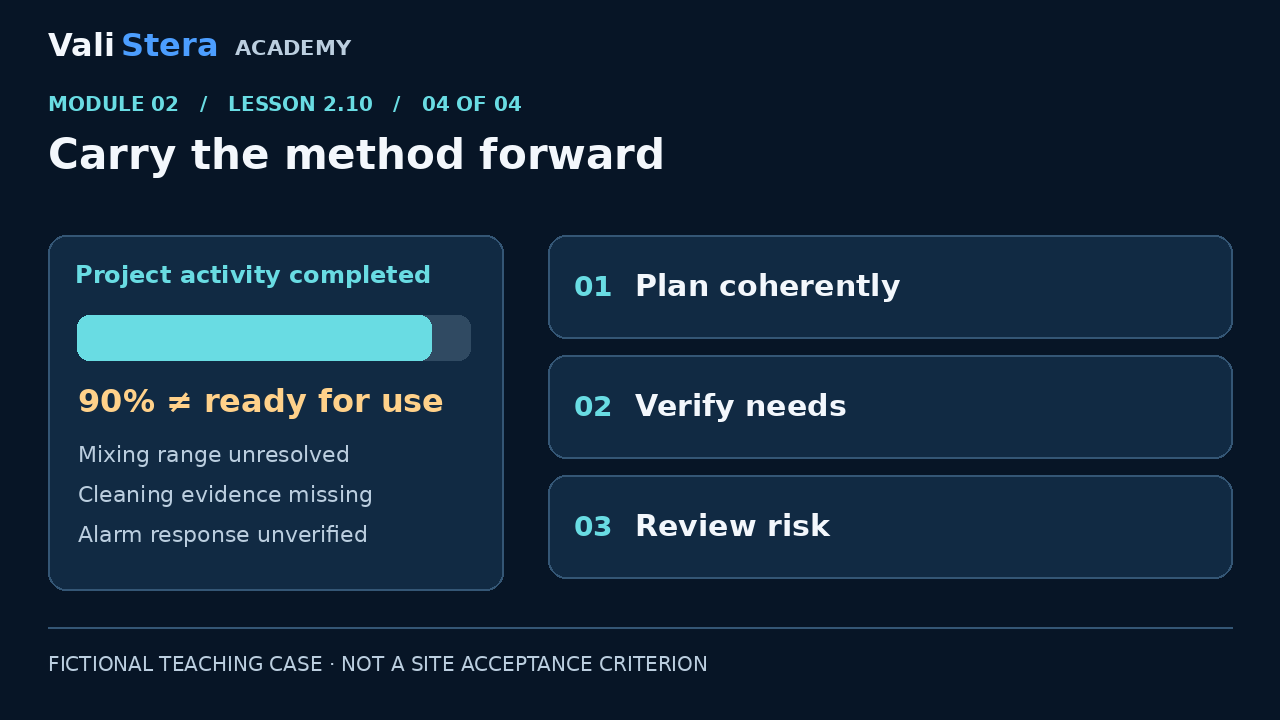
Complete the workbook and final assessment, then compare your capstone with the model reasoning. You should now be able to explain the purpose of the programme plan, draft testable requirements, connect them to evidence and discuss risk without hiding behind scores. These self-study results are not a formal qualification or competency record. Apply the method with qualified colleagues, current requirements and approved site procedures when working on a real project.
Worked artefact: two different handover decisions
Additional fictional case facts: installation identification and electrical safety checks are complete. Transfer-hose cleaning evidence and product mixing range remain open. A separate, approved dry control-panel simulation uses no product, water or transfer hose. Its hazard review finds no interaction with those gaps. The responsible site reviewers have not yet signed its stage authorization.
| Decision field | Filled teaching decision |
|---|---|
| Requested activity A | Routine oral-solution manufacture: NOT READY. Mixing and cleaning gaps affect intended use; 90% activity completion does not remove them. |
| Requested activity B | Dry control-panel simulation: propose CONDITIONAL progression only, subject to documented no-significant-impact assessment and authorized stage release. This model is a recommendation, not permission. |
| Restrictions | No product, no wetted operation, no transfer-hose use, no reliance on unverified alarm performance; follow approved simulation and safety controls. |
| Open actions / owners | Process owner supplies mixing-range basis; cleaning specialist completes hose evidence; validation executes alarm challenge. Close affected evidence before routine-use review. |
| Stop / reassess | If the simulation requires wet operation or relies on the unresolved control, stop and reassess. Conditional progression is then unsupported. |
| Acceptance record | Signatures and dates: NOT PROVIDED. Annex 15 §2.10 permits justified conditional next-stage progression; it is not a blanket release for routine manufacture. |
Now change one fact: the proposed next activity uses the transfer hose. Explain why the same conditional decision no longer holds. A defensible answer names the specific activity, dependencies and authority—not merely “conditional”.
Apply it · Activity 10
Prepare a one-page handover decision with evidence, gaps, owners, actions and conditions for reconsideration.
Compare with model reasoning
Routine-use readiness is not demonstrated. Resolve the mixing-range basis, transfer-cleaning evidence and alarm-response verification with named functions and controlled records. Reassess risk/traceability and seek the applicable authorized decision. Do not invent signatures.