Write testable user requirements
Turn vague purchase language into verifiable requirements.
2.1 minutes · English captions · Transcript + illustrated learning notes
This lesson has required companion reading below, including material not spoken in the video. Complete it before the assessment.
English captions available in the video player.
Narration and visual explanations
This transcript represents the recorded lesson using conventional written abbreviations and numerals. Open View technical information to see each diagram and its explanation. This lesson has required companion reading below, including material not spoken in the video. Complete it before the assessment.
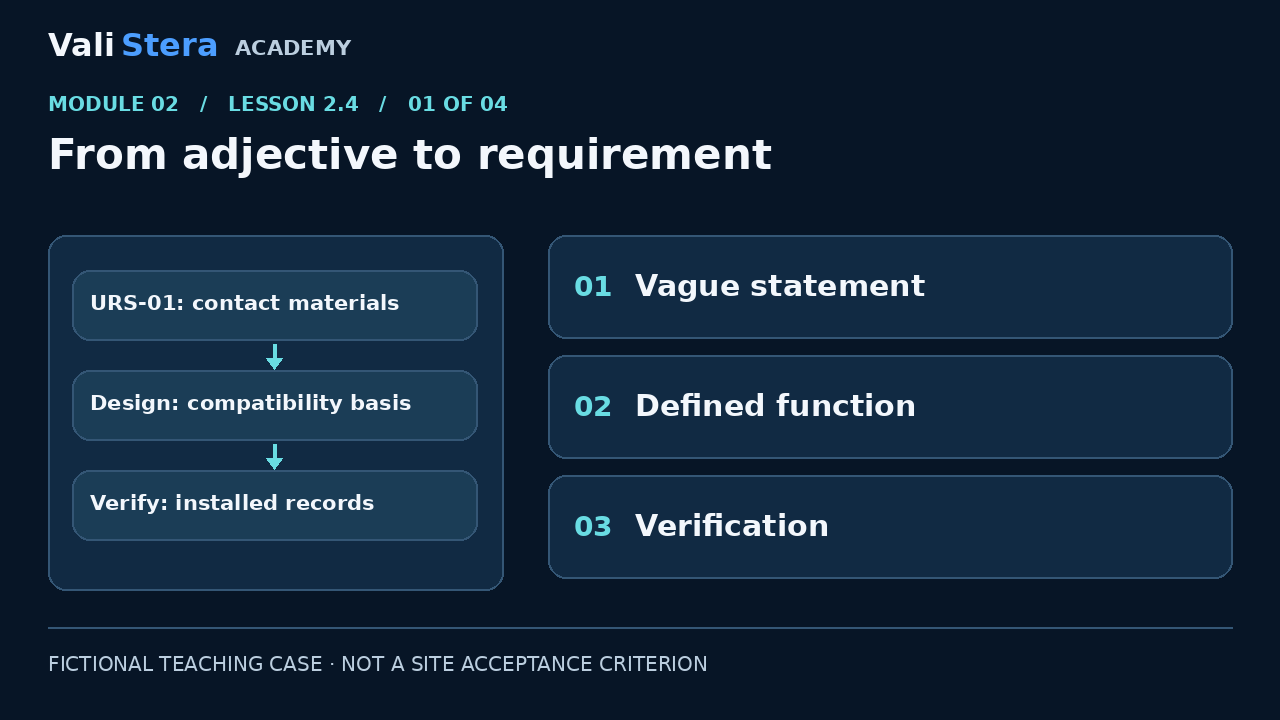
From adjective to requirement
View technical information · Diagram 1
Lesson explanation
A user requirement should communicate an actual need. The phrase easy to clean is useful as a concern but too vague to verify on its own. Ask what product residues are expected, which surfaces must be accessible, what cleaning process is intended and how the design will support it. Do not insert a universal surface finish or residue limit simply because another project used it. The scientific basis belongs to the actual application.
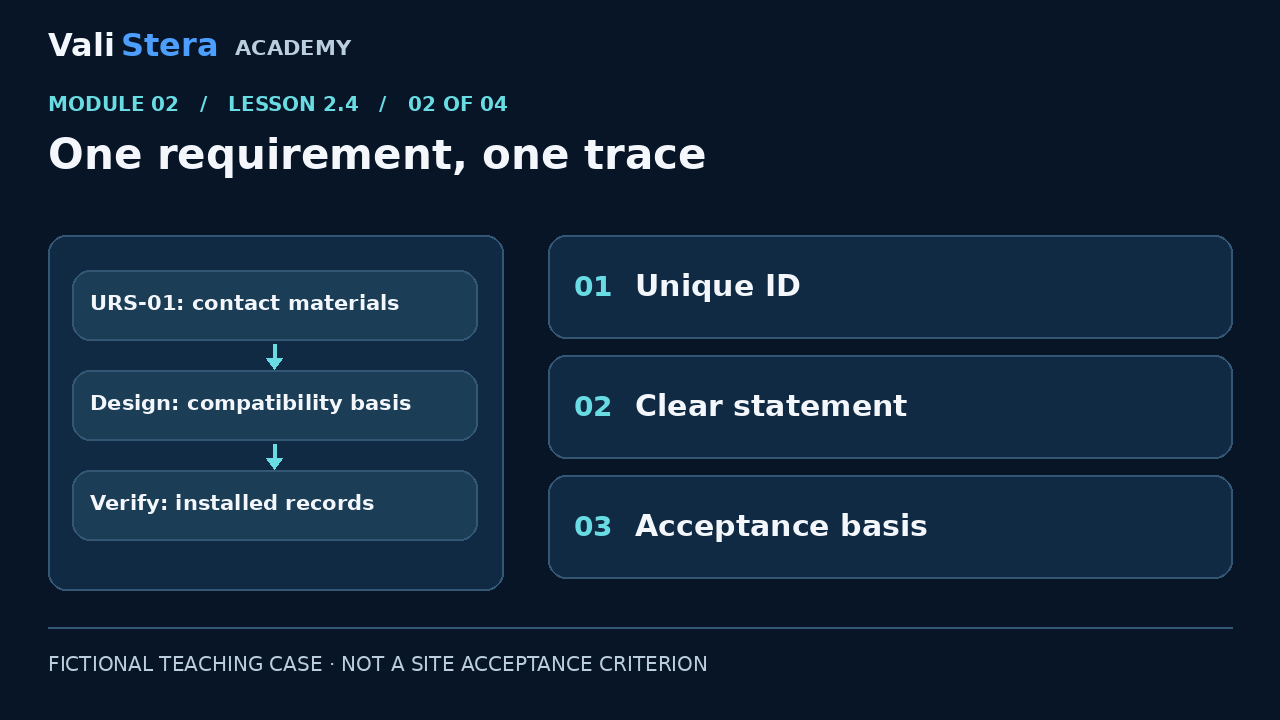
One requirement, one trace
View technical information · Diagram 2
Lesson explanation
For our fictional example, requirement URS-01 states that product-contact materials must be identified and supported by approved compatibility evidence for the defined product and cleaning agents. The design review checks the proposed materials. Later verification checks the installed materials and supporting records. The requirement has an identifier, a clear subject and an evidence path. The site defines the actual acceptance criteria and document controls.
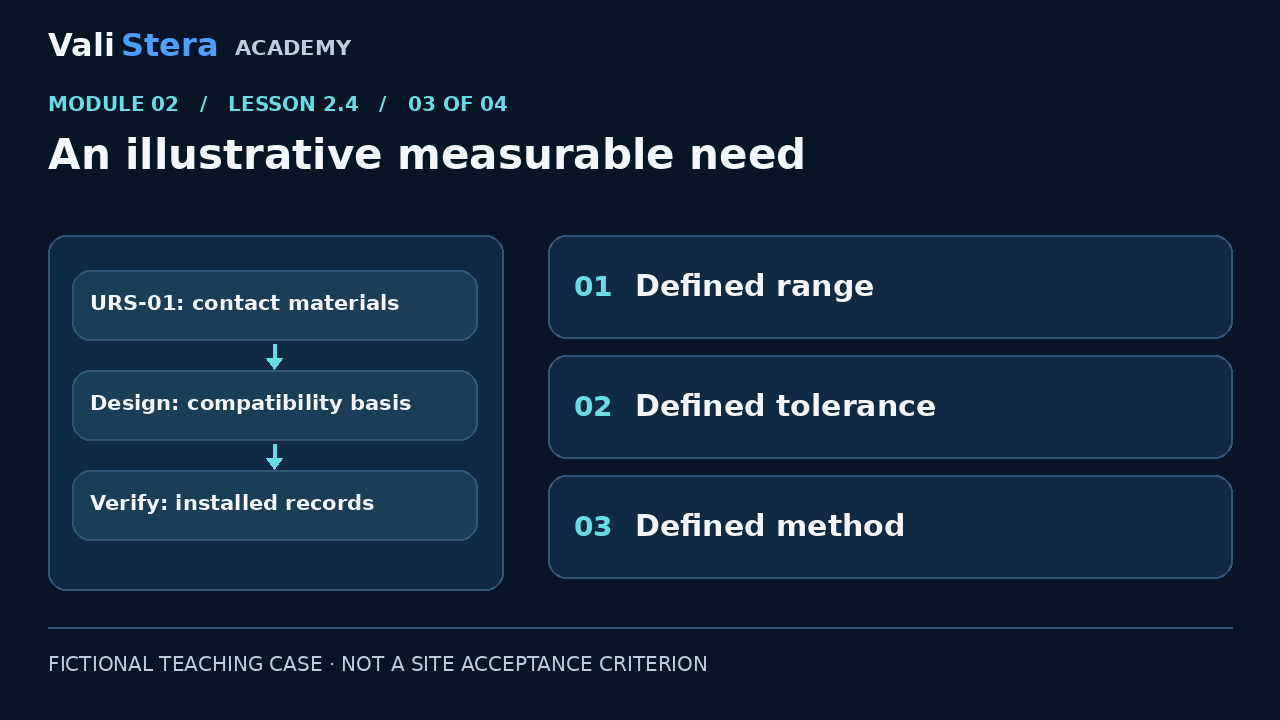
An illustrative measurable need
View technical information · Diagram 3
Lesson explanation
Consider a training-only temperature indication requirement: within the selected operating range, indication error must remain within a project-defined tolerance when compared with a suitable calibrated reference. The range and tolerance are not supplied here because the process basis is still missing. This is a deliberate unresolved requirement, not a pass. The exercise asks you to identify the information needed to finalize it before procurement or testing.
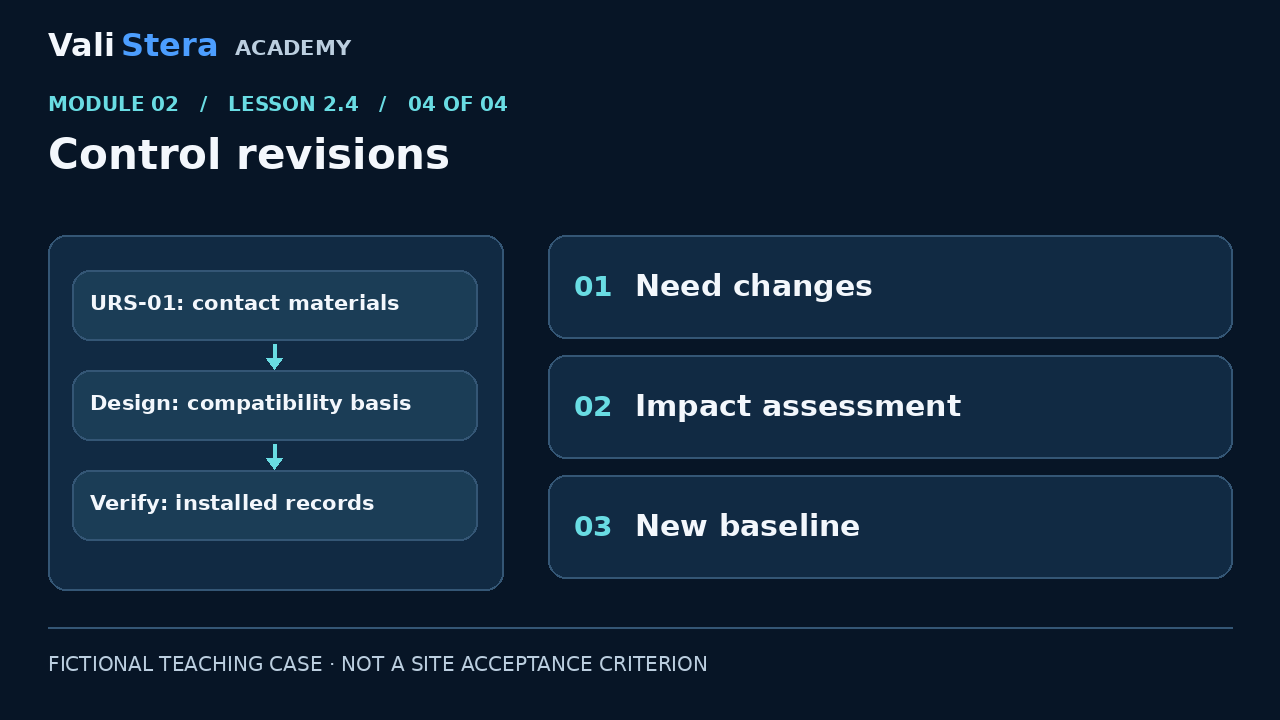
Control revisions
View technical information · Diagram 4
Lesson explanation
Requirements evolve as knowledge improves, but uncontrolled changes break traceability. If the intended batch range changes, assess effects on mixing, measurement, cleaning and verification. Retain the reason for the revision and the approval trail. Do not silently edit a requirement after a failed test to make the result pass. In the activity, rewrite three vague statements and clearly mark any assumptions that require resolution.
Required reading: name the qualification stages
URS and/or functional specification → DQ → applicable FAT/SAT → IQ → OQ → PQ. This is a learning map, not a mandatory identical sequence for every project. Document justified combinations and applicability.
DQ verifies the URS against the design. FAT/SAT examine supplier/site acceptance. IQ checks installation; OQ checks operation and limits; PQ checks intended performance. Keep the URS as the lifecycle reference (Annex 15 §§3.1–3.14).
For V-201, trace URS-02 through design drawing DR-02, applicable factory checks, installed sensor identification, operational accuracy testing, and performance evidence under the intended load. A supplier pass alone does not close every stage.
Worked artefact: a measurable URS
Supplemental worked-example assumption only: the base V-201 project has no supplied or approved process range or tolerance. For this separate fictional illustration, assume a process owner has provisionally proposed a 20–60 °C indication range and maximum absolute error of 0.5 °C in draft teaching document PB-02. These are not approved project criteria; site justification and authorization remain outstanding. These numbers are not general GMP tolerances.
| Field | Filled teaching example |
|---|---|
| ID / need | URS-02: reliable temperature indication for V-201. |
| Requirement | At steady reference temperatures of 20, 40 and 60 °C, the installed indication shall differ from the traceable reference by no more than ±0.5 °C at each point, in the approved test configuration. |
| Verification basis | OQ-02 defines stabilization, reference uncertainty, repeat readings, sensor location and decision rule before execution. No averaging away an individual failure. |
| Responsibility / status | Process owner must justify PB-02; validation drafts OQ-02; authorized site reviewers must approve both before execution. This is a proposed teaching requirement, not an approved specification. |
| Boundary | This tests indication accuracy; it does not demonstrate mixing uniformity or product suitability. |
URS-01 remains a documentary material-suitability requirement: verification by records can be valid. URS-02 illustrates a separately measurable requirement. Reject “temperature shall be accurate” because it lacks conditions and a criterion.
Apply it · Activity 4
Rewrite “accurate sensor”, “easy to clean” and “secure records” into verifiable requirements with unresolved inputs marked.
Compare with model reasoning
Define the measured variable, intended range, justified tolerance and comparison method; define cleaning access and compatibility evidence; define authorized access, attributable records and retention/retrieval needs. Do not invent site limits.