Trace requirements into verification
Follow a requirement from design to objective evidence.
2.0 minutes · English captions · Transcript + illustrated learning notes
This lesson has required companion reading below, including material not spoken in the video. Complete it before the assessment.
English captions available in the video player.
Narration and visual explanations
This transcript represents the recorded lesson using conventional written abbreviations and numerals. Open View technical information to see each diagram and its explanation. This lesson has required companion reading below, including material not spoken in the video. Complete it before the assessment.
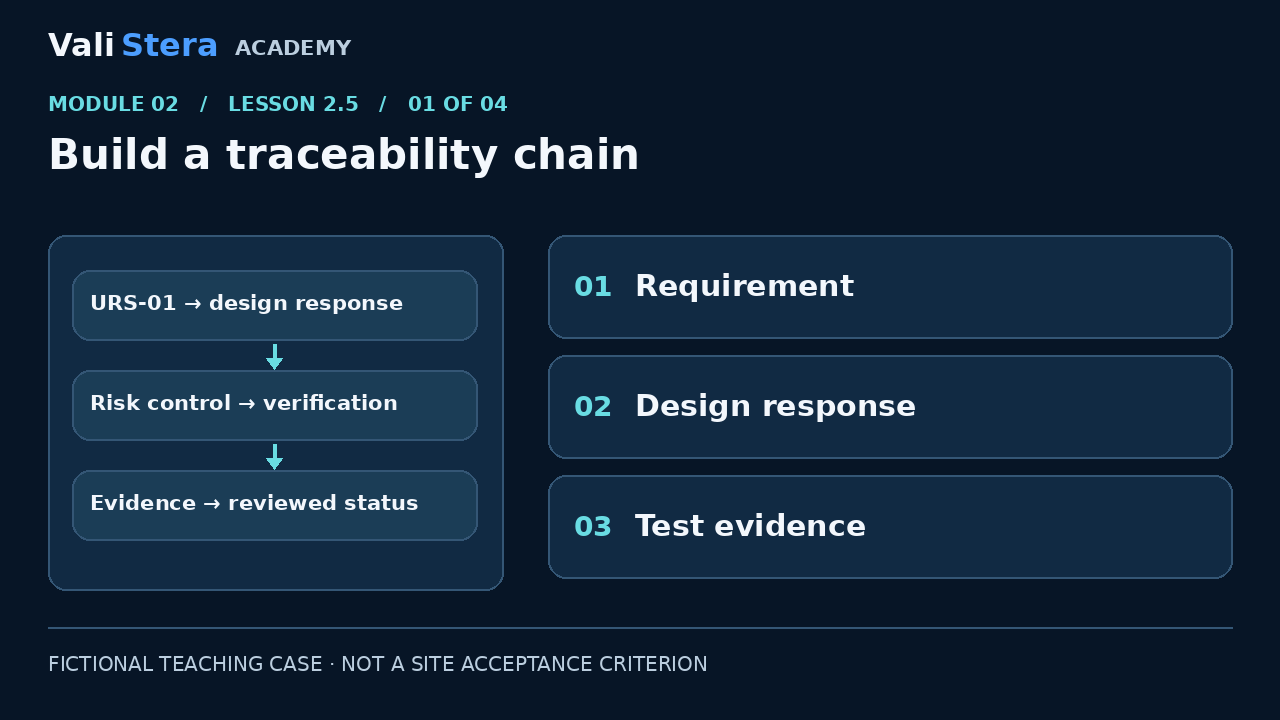
Build a traceability chain
View technical information · Diagram 1
Lesson explanation
A traceability matrix is a practical teaching tool for connecting needs to evidence. Each row links a requirement to its design response, relevant risk control, verification activity and result. A check mark is not enough if the underlying record cannot be located. For our vessel, the product-contact-material requirement links to a design specification, installed material records and the review that confirms suitability for the intended use.
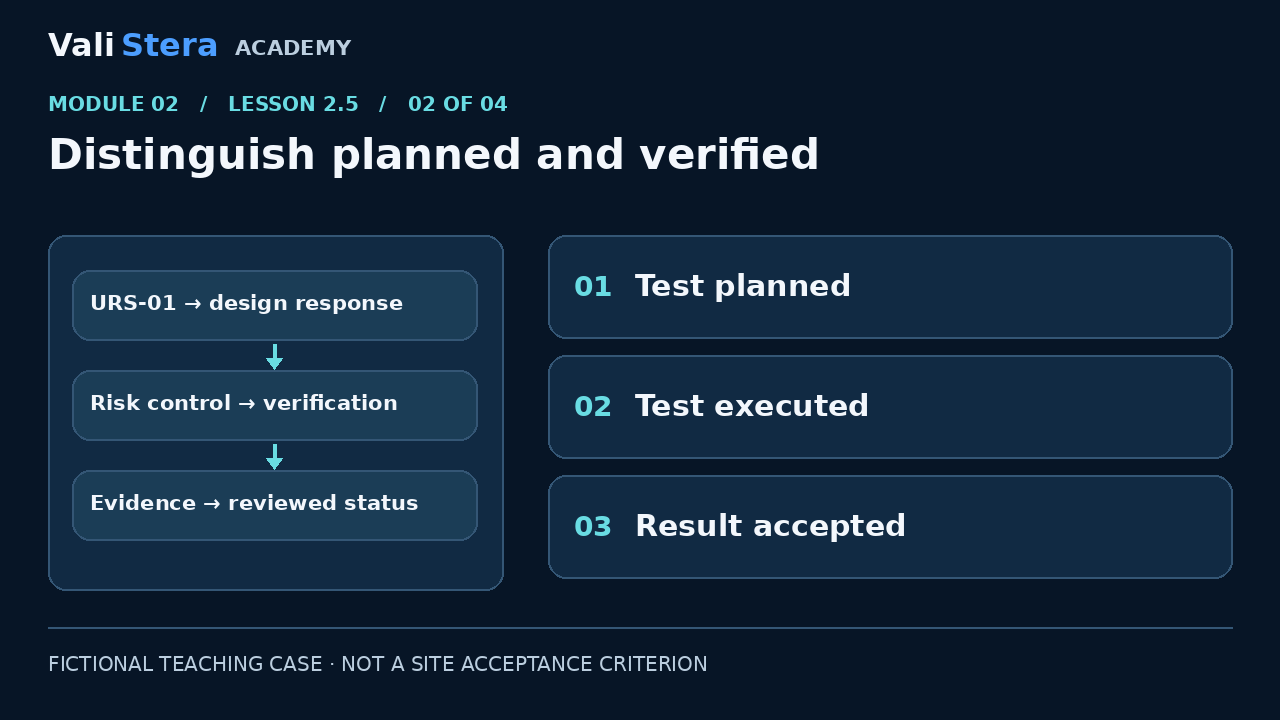
Distinguish planned and verified
View technical information · Diagram 2
Lesson explanation
The three cards show different states. A planned test has an approved method but no result. An executed test has observations, which may include a failure. An accepted result has been evaluated against the applicable criteria with deviations addressed appropriately. Keeping these states separate prevents a dashboard from showing green simply because someone uploaded a file. The evidence must answer the requirement, not merely share its title.
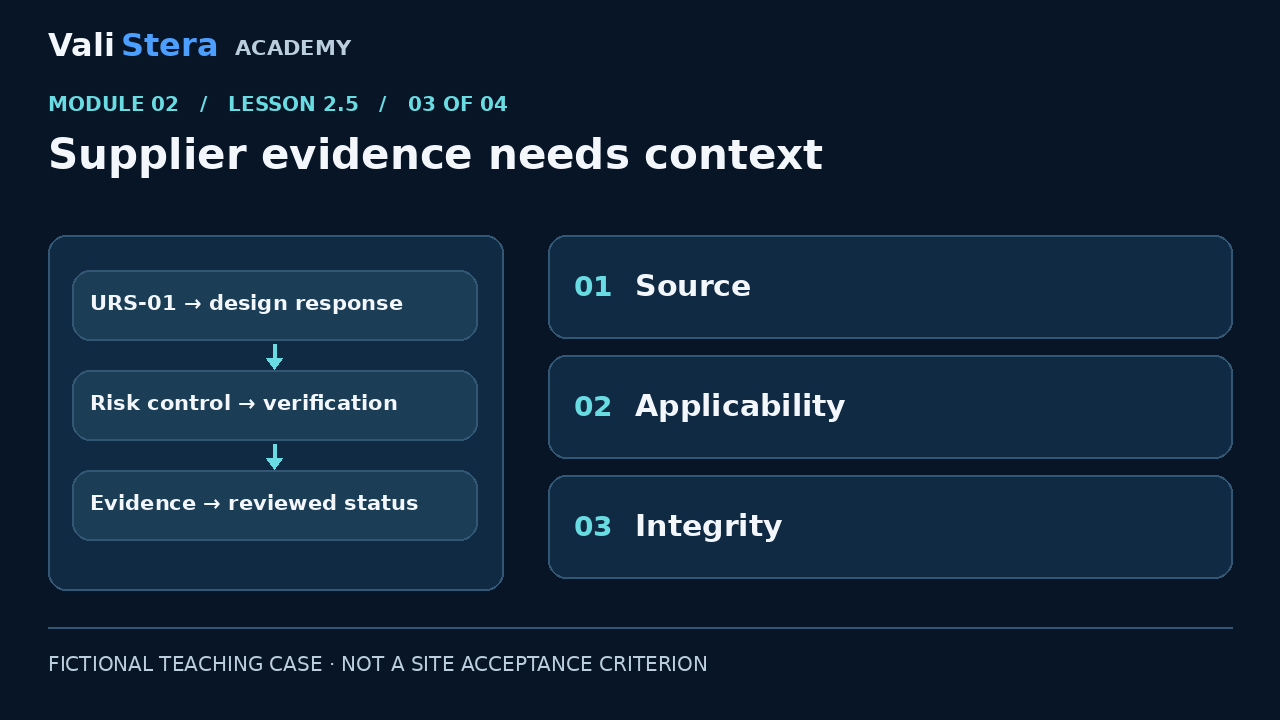
Supplier evidence needs context
View technical information · Diagram 3
Lesson explanation
A supplier may provide useful testing and design records. Review whether they apply to the purchased configuration, use appropriate methods and preserve reliable data. Transport, installation or configuration changes can affect whether a result remains applicable. Our example is a factory test of an alarm that depends on a site-installed sensor. The team must assess what needs verification after installation. A supplier signature does not settle that question automatically.
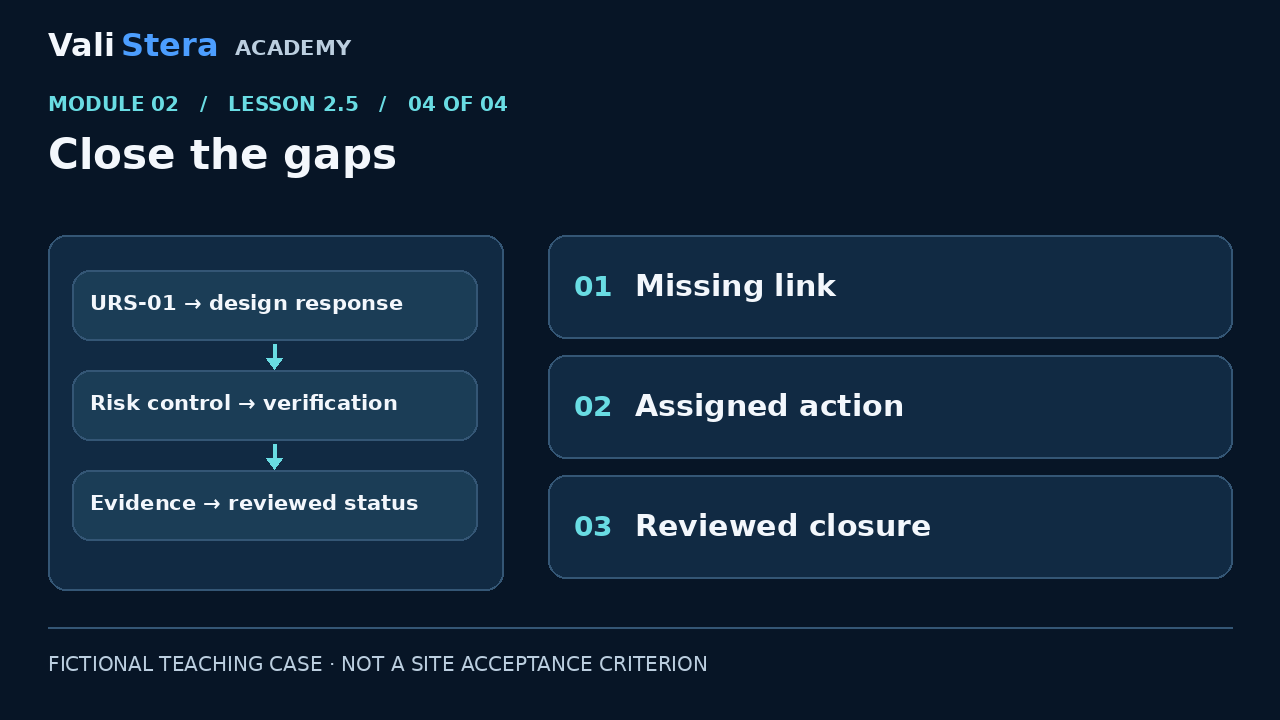
Close the gaps
View technical information · Diagram 4
Lesson explanation
In the activity, construct five traceability rows. Mark the status honestly and identify the next action for each gap. A requirement with no test may need a new verification method. A test with no requirement may reveal an undocumented need or unnecessary work. Traceability should support technical thinking in both directions. It is a means of exposing missing evidence, not a substitute for judging whether that evidence is adequate.
Required reading: name the qualification stages
URS and/or functional specification → DQ → applicable FAT/SAT → IQ → OQ → PQ. This is a learning map, not a mandatory identical sequence for every project. Document justified combinations and applicability.
DQ verifies the URS against the design. FAT/SAT examine supplier/site acceptance. IQ checks installation; OQ checks operation and limits; PQ checks intended performance. Keep the URS as the lifecycle reference (Annex 15 §§3.1–3.14).
For V-201, trace URS-02 through design drawing DR-02, applicable factory checks, installed sensor identification, operational accuracy testing, and performance evidence under the intended load. A supplier pass alone does not close every stage.
Worked artefact: a traceability record
| Link | Filled teaching record |
|---|---|
| Requirement / design | Illustrative proposal only: URS-02 → draft PB-02 → DR-02 sensor and display specification. DQ-02 would check the design after the range and accuracy are justified and approved. |
| Risk / stage | RA-02: misleading indication. FAT-02 may support design evidence; IQ-02 confirms installed sensor identity and calibration; OQ-02 tests the installed chain. |
| Evidence / decision | In a hypothetical execution assuming approved ±0.5 °C criteria, OQ-02 row 3 gives +0.6 °C at 60 °C: numerical failure. DEV-02 would remain open. Base-project URS-02 remains unverified; no actual test occurred. |
| Action / owner | If this were executed, instrument engineering would investigate; validation would repeat affected tests under approved deviation handling; Quality would review impact before closure. |
| PQ boundary | PQ must address intended process performance. Passing OQ-02 alone does not establish product uniformity. |
For third-party protocols, site personnel assess suitability and compliance with internal procedures before approval (Annex 15 §2.6). Evaluate configuration, raw data, acceptance basis and transport/installation effects before reusing supplier results (§3.6).
Apply it · Activity 5
Create five requirement-to-evidence rows using the downloadable traceability worksheet.
Compare with model reasoning
Include materials, measurement, mixing range, cleaning and records. Give each an ID, design response, verification method, evidence reference, status and open action. Use pending where evidence is absent.