Ask a precise risk question
Separate hazard, failure mode, harm and uncertainty.
2.0 minutes · English captions · Transcript + illustrated learning notes
This lesson has required companion reading below, including material not spoken in the video. Complete it before the assessment.
English captions available in the video player.
Narration and visual explanations
This transcript represents the recorded lesson using conventional written abbreviations and numerals. Open View technical information to see each diagram and its explanation. This lesson has required companion reading below, including material not spoken in the video. Complete it before the assessment.
Define the question
View technical information · Diagram 1
Lesson explanation
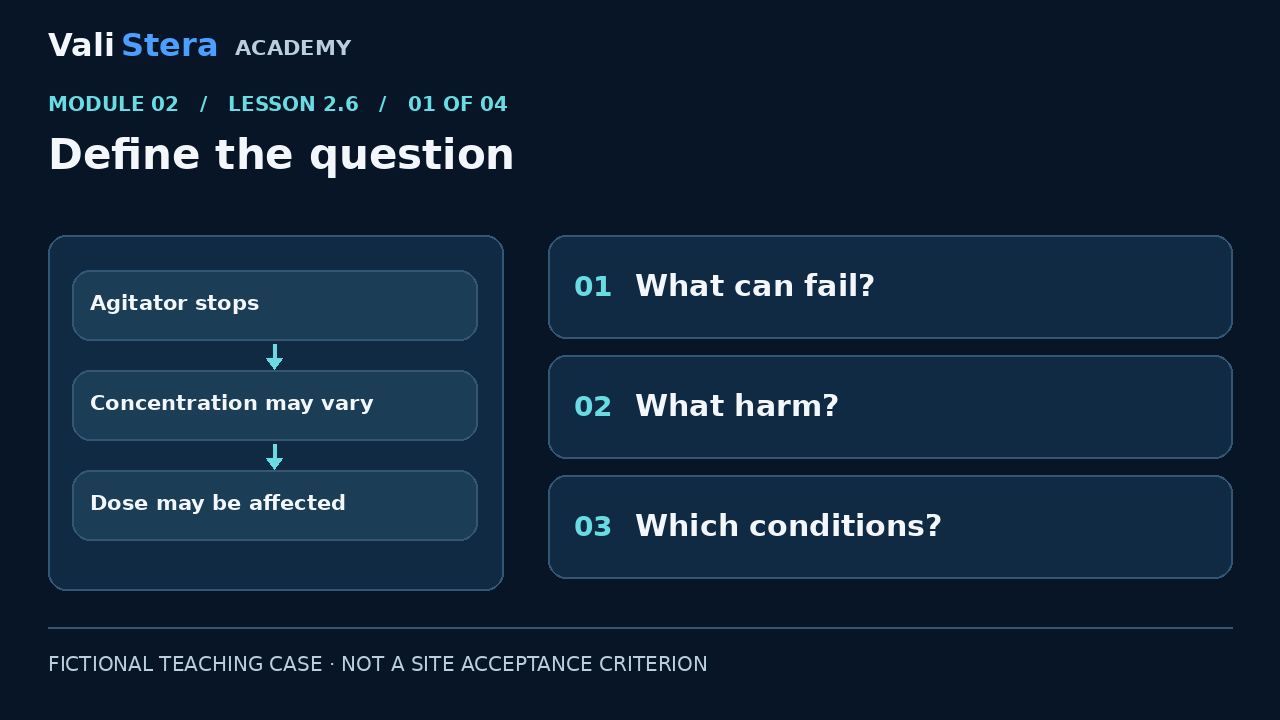
For this project, ask: could inadequate mixing within the intended batch range lead to non-uniform product before transfer? This is more useful than asking whether the vessel is risky. The question identifies a possible failure, product consequence and operating context. Our diagram shows the possible chain from lost mixing to variable concentration and a potentially affected dose. It is not measured process data and does not prove that any real vessel performs poorly.
Separate the concepts
View technical information · Diagram 2
Lesson explanation
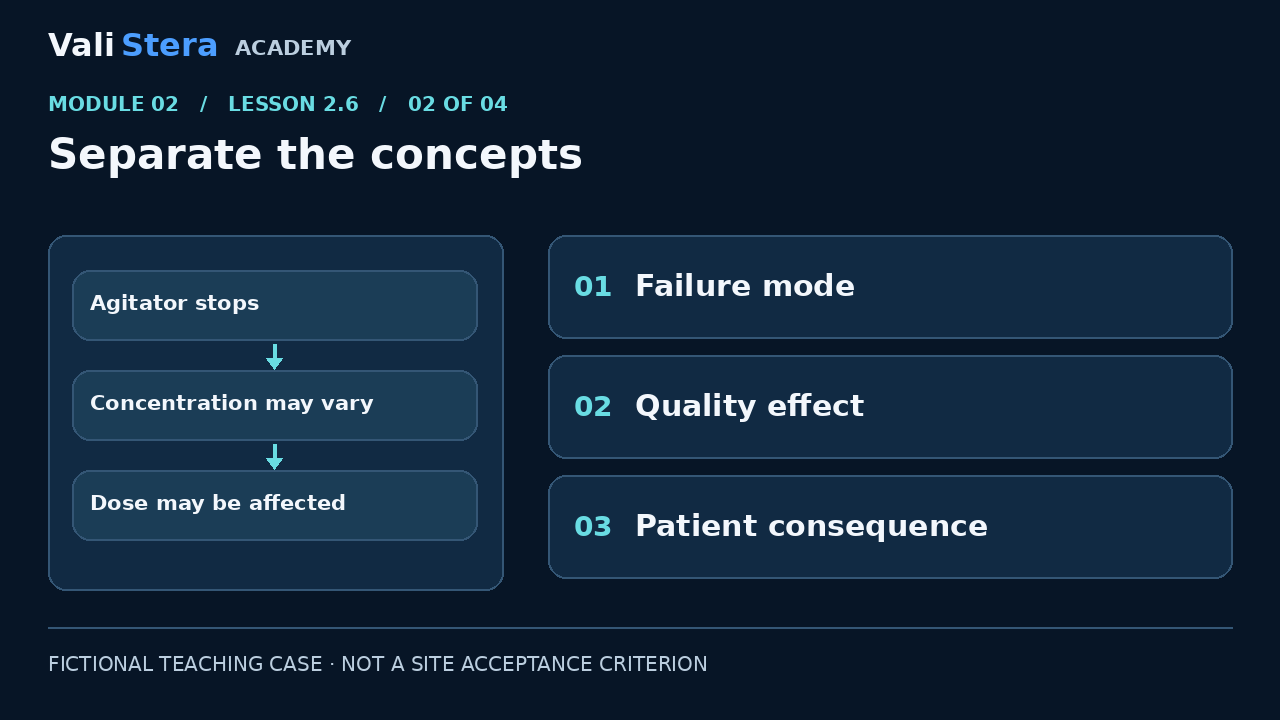
A stopped agitator is a failure mode. Non-uniform concentration may be a product-quality effect, depending on the formulation and process. An incorrect delivered dose may be a patient consequence. These links require scientific understanding; they are not automatic for every liquid. The exercise asks you to explain the chain and list the evidence needed to judge it. Avoid assigning a score before you understand the scenario.
Make uncertainty visible
View technical information · Diagram 3
Lesson explanation
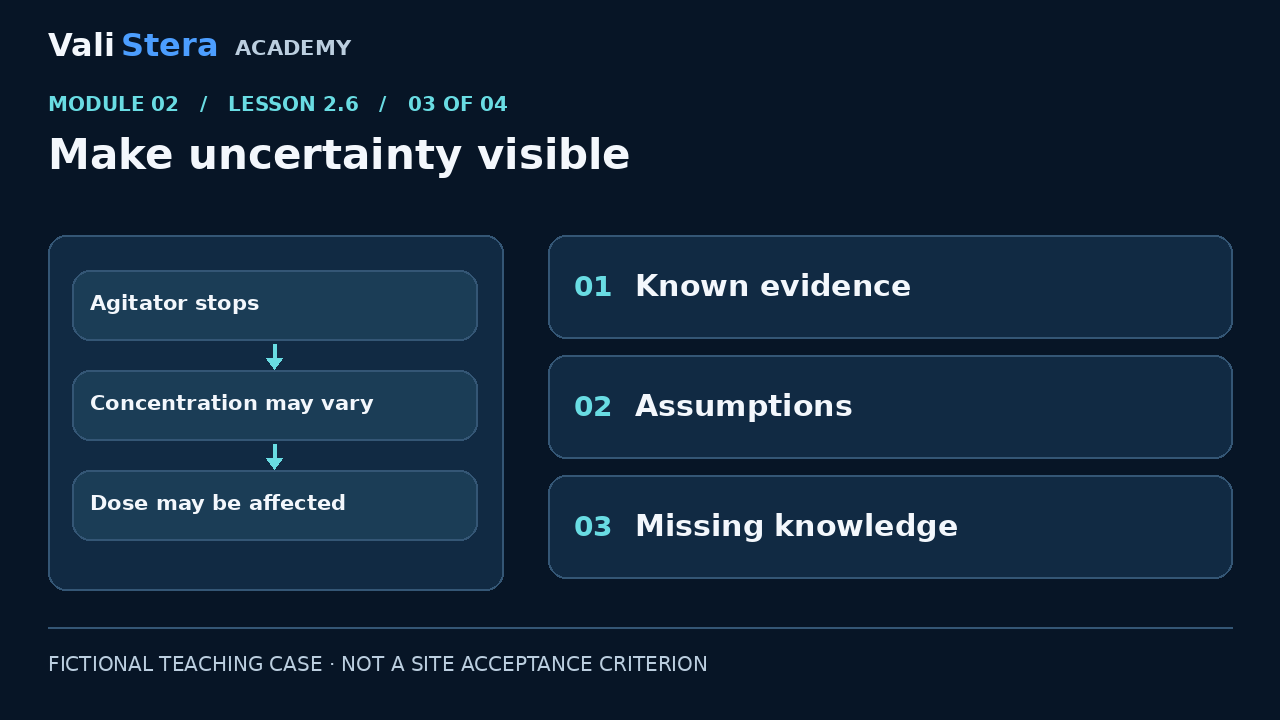
ICH Q9(R1) links risk decisions to scientific knowledge and patient protection. The degree of formality should reflect risk, uncertainty, importance and complexity. For our case, a small development study may not represent the full batch range. Record that limitation and plan how to reduce uncertainty. A low number based on a guess is not stronger evidence than a clearly stated unknown.
Choose the right discussion
View technical information · Diagram 4
Lesson explanation
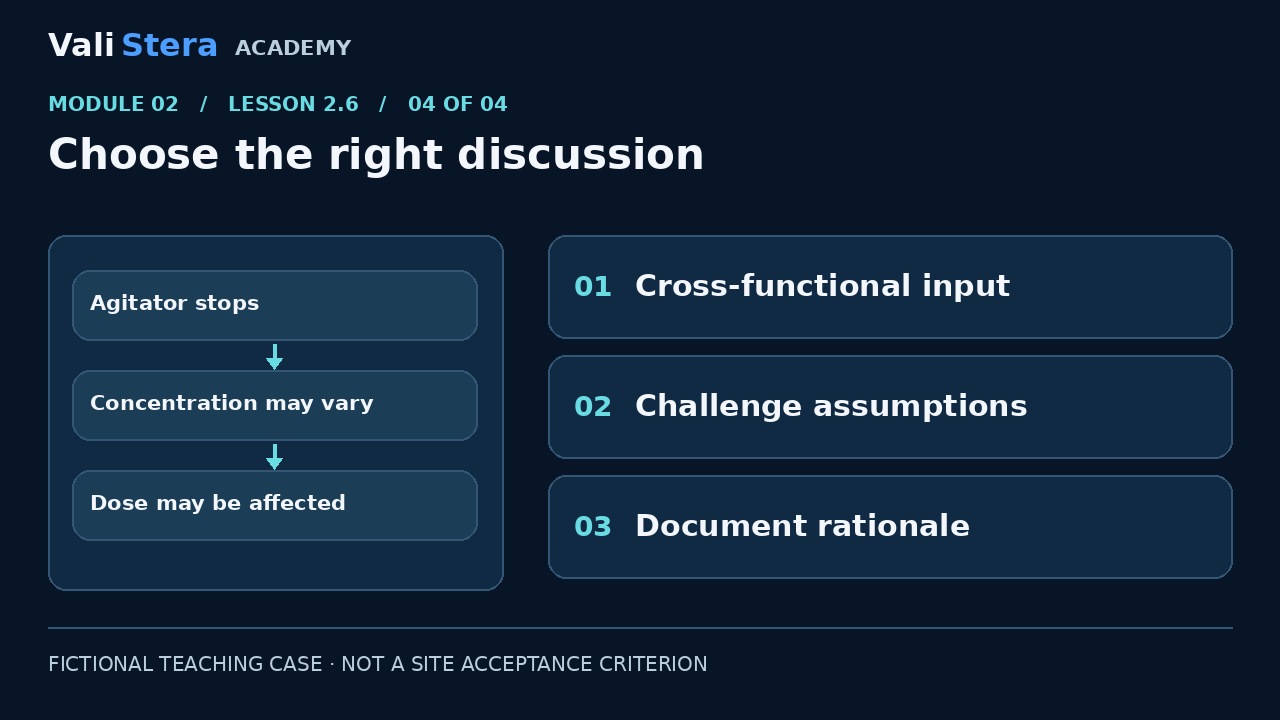
Invite people who understand the process, equipment and potential consequences. Ask each person which assumptions could be wrong and what evidence would change the decision. If the project deadline is influencing scores, make that bias explicit. In the activity, write one risk question and one cause-to-harm chain. Keep the language specific enough that another reviewer can disagree with it constructively and identify what needs checking.
Required reading: risk vocabulary
Hazard: a potential source of harm. Harm: damage to health, including effects arising from lost product quality or availability. Risk combines the probability of harm and its severity. Severity describes how serious the consequence is; probability describes how likely it is. Detectability describes the ability to discover a hazard or failure. These are plain-language paraphrases of ICH Q9(R1) §7, not verbatim definitions.
V-201 example: inadequate mixing is the hazardous situation; stopped agitation is a failure mode; a drive fault is a possible cause; non-uniform concentration is a quality effect; incorrect dose and patient injury are possible downstream harms. The chain is conditional, not proof of a patient outcome. Uncertainty includes missing mixing studies and unknown failure frequency.
Distinguish the probability of equipment failure from the probability of resulting patient harm: intermediate controls and exposure matter.
Apply it · Activity 6
Write a risk question for mixing and another for cleaning; identify one uncertainty in each.
Compare with model reasoning
Example: could incomplete drainage after cleaning retain residue that affects the next product? Clarify residue characteristics, equipment geometry and cleaning evidence. Mixing uncertainty may involve viscosity or batch-volume range.