Use risk to focus the design review
Prioritize design scrutiny using failure mechanisms and evidence rather than a score alone.
2.1 minutes · English captions · Illustrations and worked example
This lesson’s core explanations and worked-example reasoning are narrated. The table restates the example for reference; the practice activity and model answer are reading exercises.
English captions available.
Narration and visual explanations
Open View Technical Explanation to see each diagram, its text description and the matching narration. Standard abbreviations and numerals are used visually.
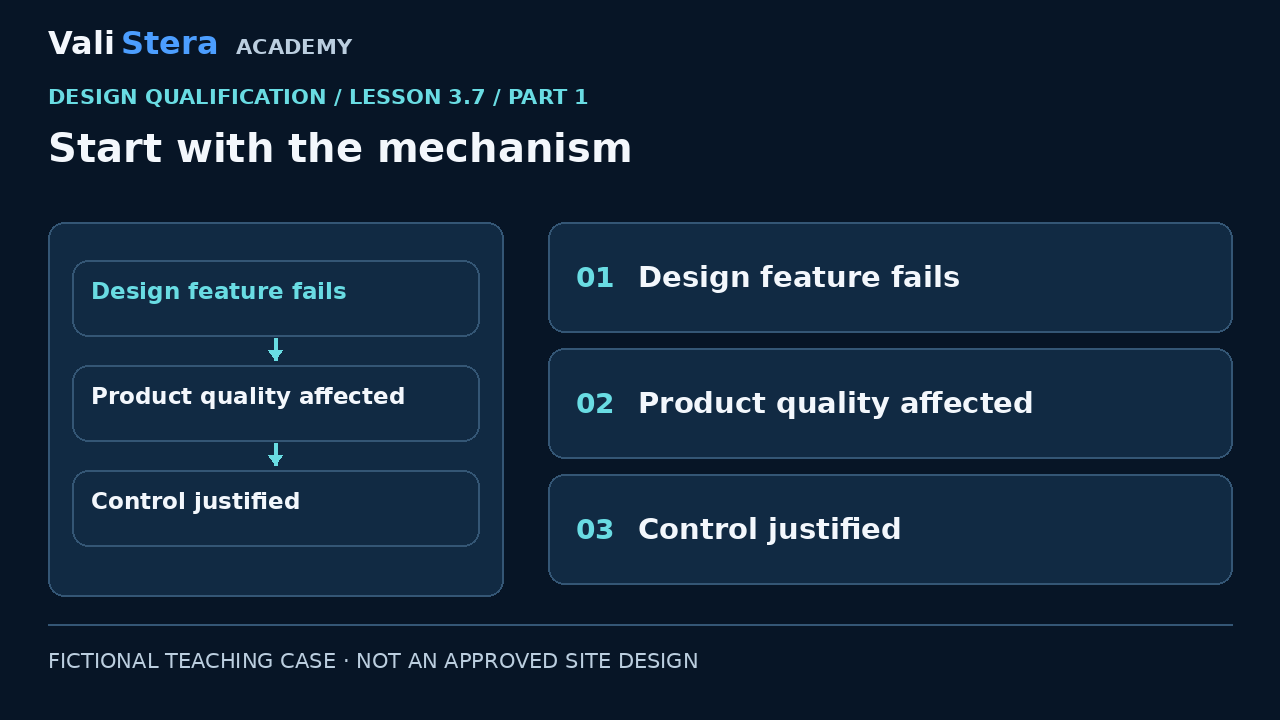
Start with the mechanism
View Technical Explanation · Diagram 1
Lesson explanation
Risk informs where the design review needs depth. In our fictional case, a missing mixing protection can permit transfer after loss of agitation, potentially affecting concentration uniformity. Explain that mechanism before assigning a priority. Another issue, such as an inconsistent drawing title, may primarily affect document control. Both require action, but their consequences differ. A risk label without an explanation gives the reviewer little basis for deciding what evidence is enough.
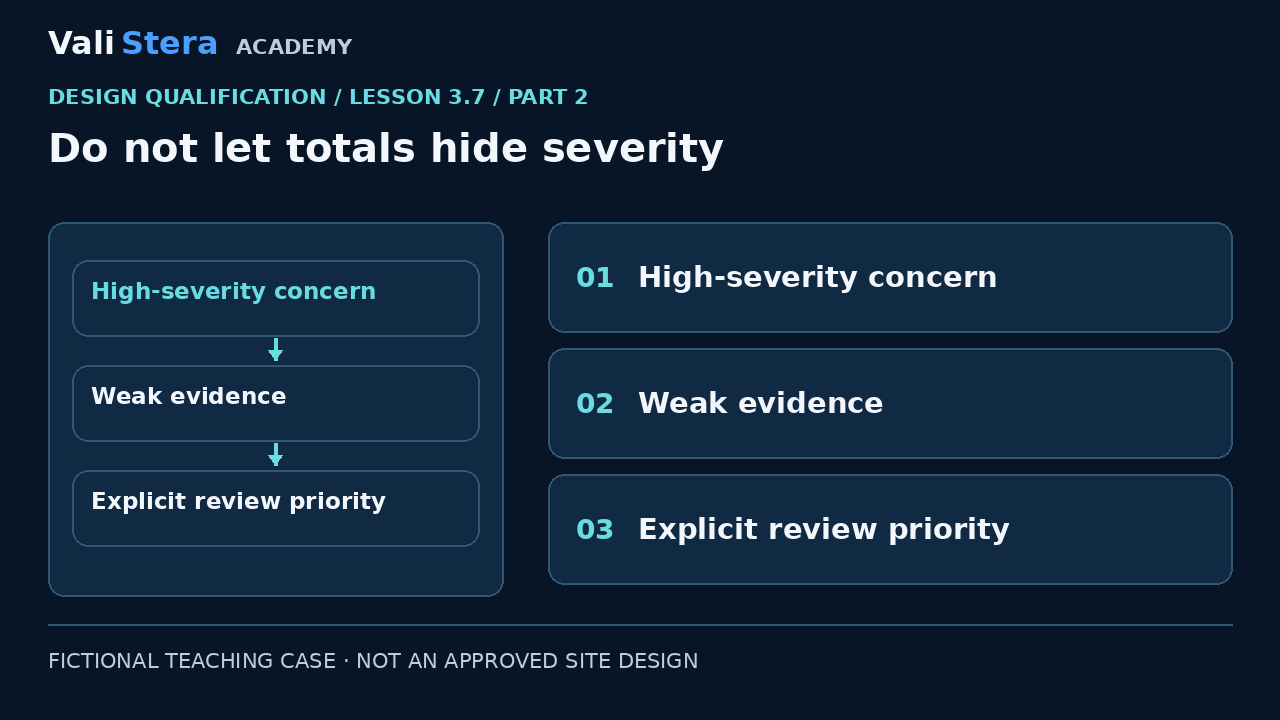
Do not let totals hide severity
View Technical Explanation · Diagram 2
Lesson explanation
A numerical risk score can organize discussion but cannot supply missing knowledge. This lesson uses no universal score threshold. If a serious failure has weak evidence for prevention or detection, keep that uncertainty visible even when an arithmetic total looks small. Review assumptions, operating conditions and dependencies. Do not reduce a risk rating merely because a proposed control appears on the drawing; its effectiveness still needs support and later verification.
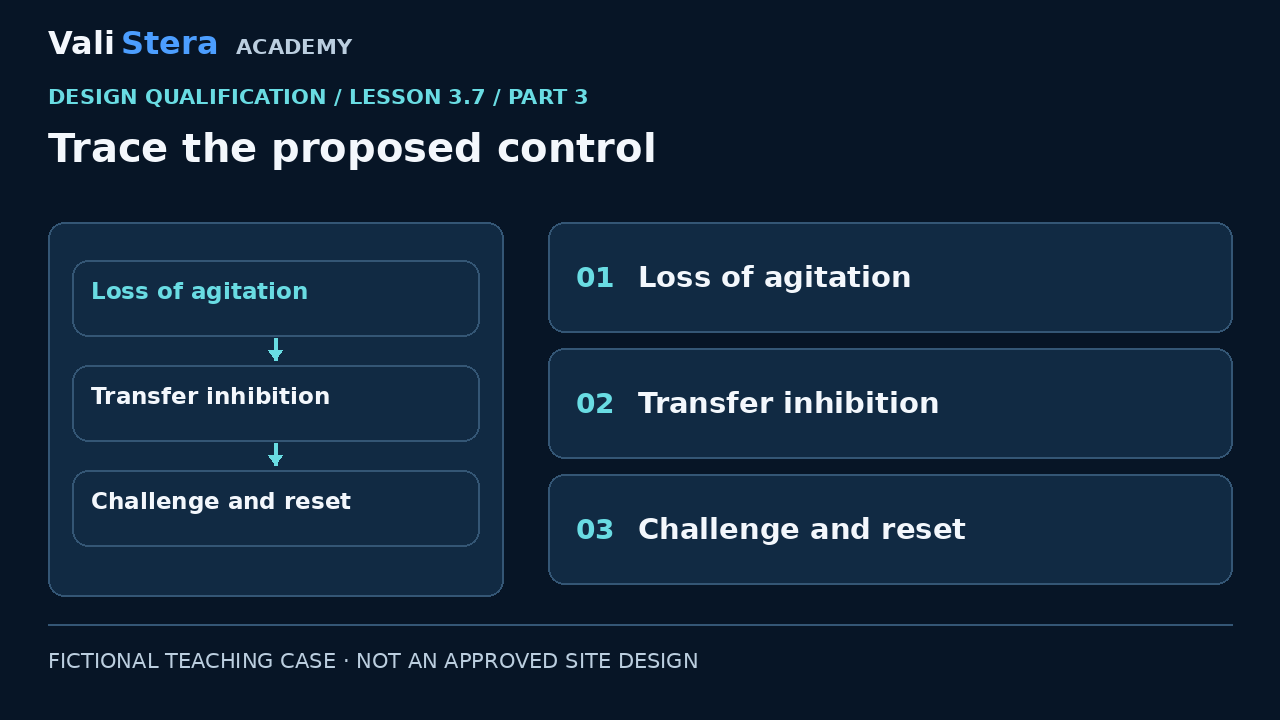
Trace the proposed control
View Technical Explanation · Diagram 3
Lesson explanation
For the mixing scenario, the proposed control inhibits transfer when loss of agitation is detected. Review sensor coverage, logic, bypass authority and reset behaviour. Ask whether the sensing arrangement could miss the failure being considered. Link the design response to a planned controlled challenge of the protective function. The teaching diagram shows failure, control and verification as connected steps, not as proof that any specific interlock is already effective.
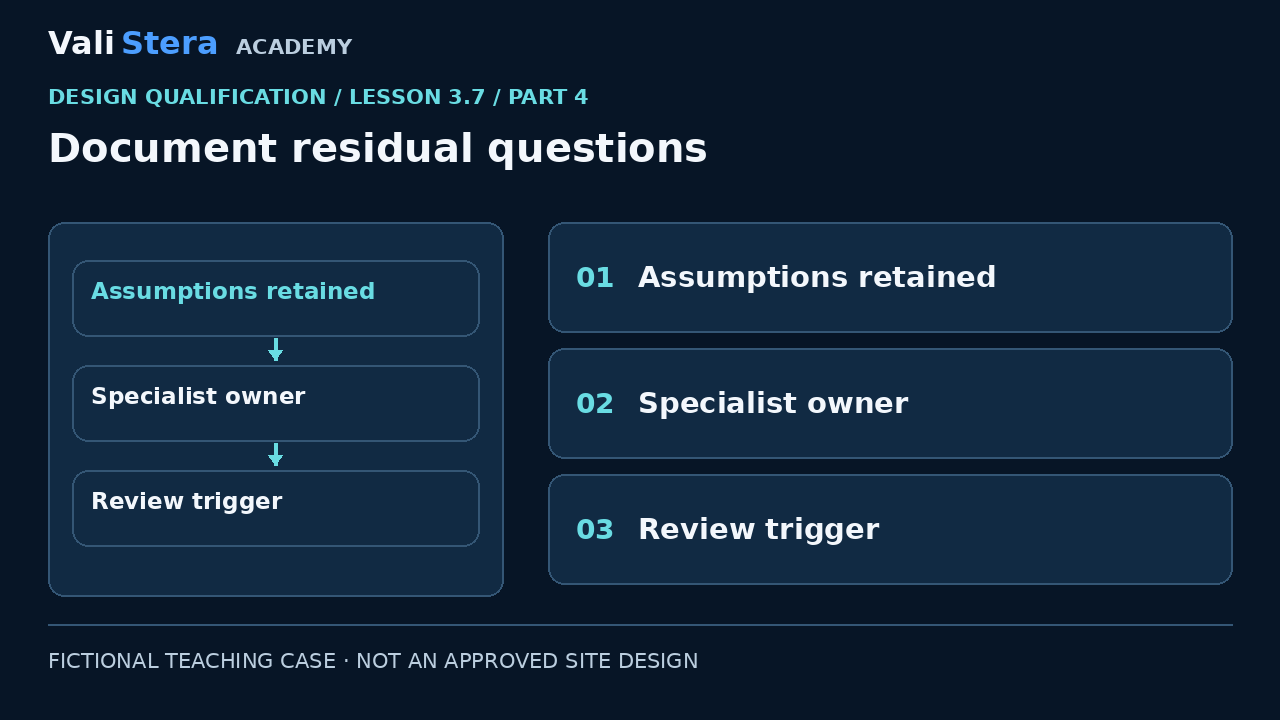
Document residual questions
View Technical Explanation · Diagram 4
Lesson explanation
A useful risk-informed review records what remains uncertain, who will resolve it and what change triggers another review. For example, a later product with different viscosity may invalidate the original mixing assumption. Keep that trigger linked to the requirements and design. Your activity is to compare two design findings and justify the depth of review for each. Do not force every question into a numerical ranking when a reasoned explanation is clearer.
Worked example
| Finding | Reasoned priority | Evidence/action |
|---|---|---|
| Transfer after loss of agitation | Potential non-uniform product; important uncertainty | Assess sensing/logic/bypass and plan challenge |
| Drawing title duplicated | Document ambiguity; assess configuration impact | Reconcile identifiers and confirm affected equipment |
| New viscosity range | Could change prior mixing assumptions | Review requirement, design and verification scope |
Apply it · Activity 7
Compare a missing transfer interlock with a duplicated drawing title. Explain review priority and required evidence without inventing scores.
Open workbook activityCompare with model reasoning
The interlock concern has a potential quality mechanism and needs process/control expertise and verification planning. The title issue needs document reconciliation and impact review; determine whether it also hides a configuration error.