Execute and record defensible observations
Preserve the relationship between criteria, observations and original evidence.
2.1 minutes · English captions · Illustrations and worked example
This lesson’s core explanations and worked-example reasoning are narrated. The table restates the example for reference; the practice activity and model answer are reading exercises.
English captions available.
Narration and visual explanations
Open View Technical Explanation to see each diagram, its text description and the matching narration. Standard abbreviations and numerals are used visually.
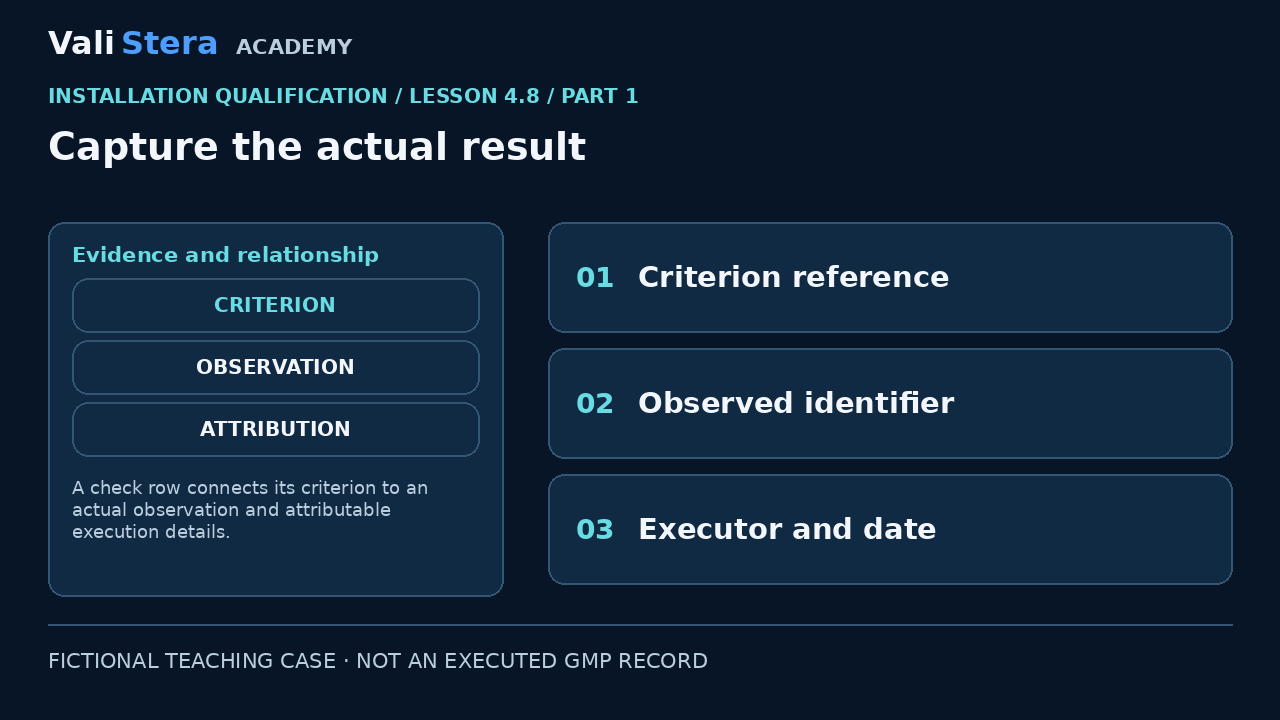
Capture the actual result
View Technical Explanation · Diagram 1
Lesson explanation
An installation record should make the comparison understandable. For the valve identity check, record the actual model and tag, the referenced schedule and the outcome. A tick without the required observation may leave a reviewer unable to reconstruct the decision. Use the approved form and record the work when performed, not from memory at the end of the week.
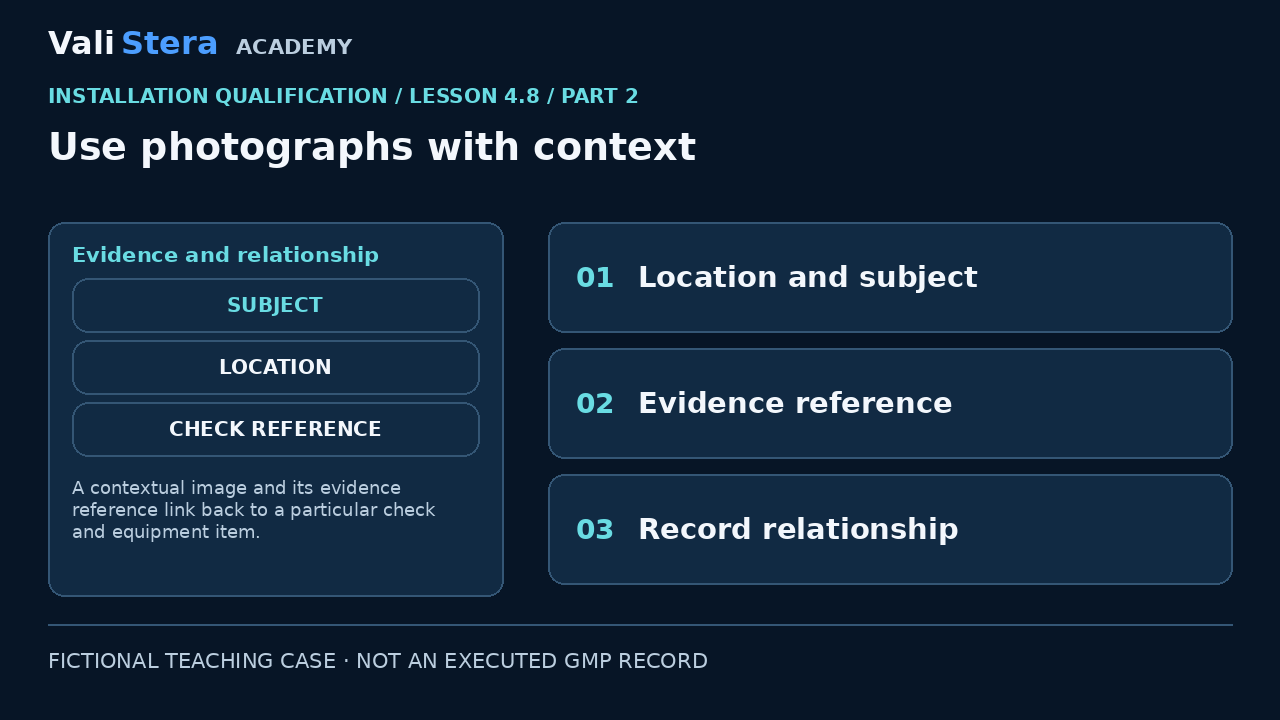
Use photographs with context
View Technical Explanation · Diagram 2
Lesson explanation
A photograph can support an observation if the relevant feature is readable and its relationship to the check is clear. Record location, subject and the controlled evidence reference. A cropped image of a plate without the equipment context may be ambiguous. Photographs supplement the specified verification method; they are not automatically sufficient for every installation characteristic.
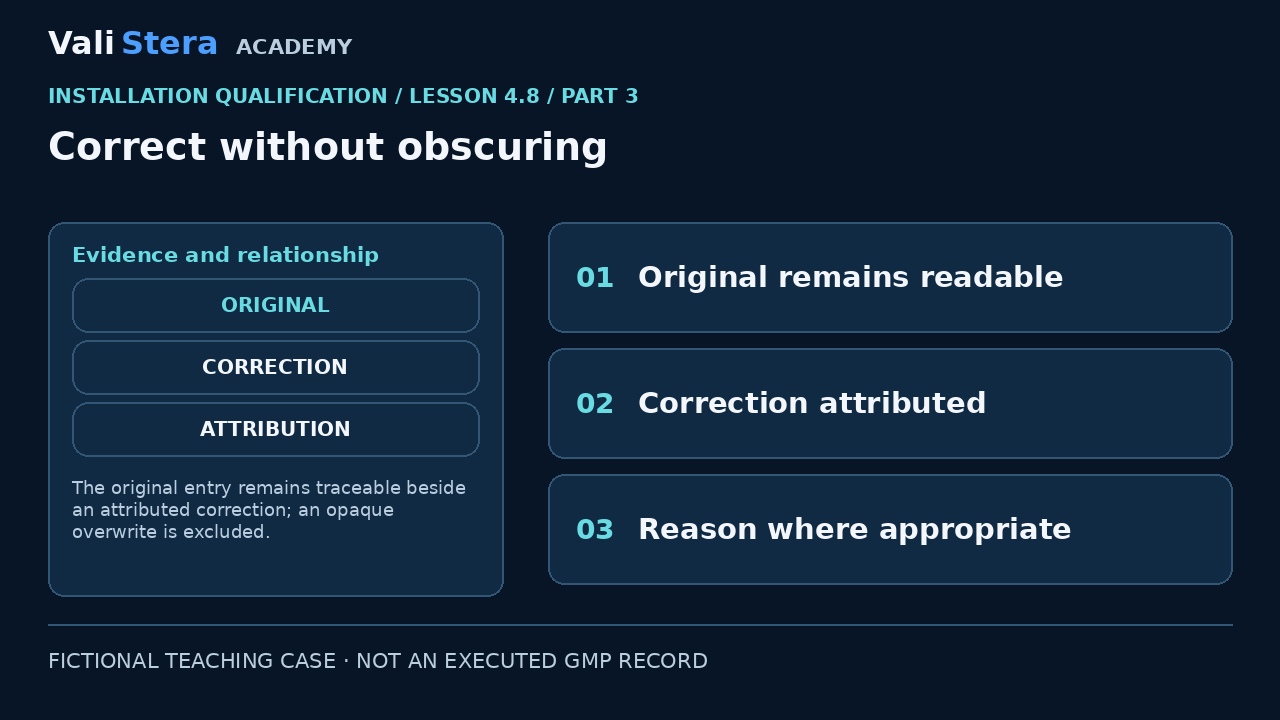
Correct without obscuring
View Technical Explanation · Diagram 3
Lesson explanation
Suppose a handwritten serial number contains a transposed digit. Correct it using the approved documentation procedure, preserving the original entry and recording the required attribution and date, with a reason where appropriate. Do not erase the original or backdate the correction. For electronic records, use the controlled system process rather than an untracked replacement file. Retain original records, printouts, photographs and raw electronic data under the defined retention schedule, with controlled locations and integrity safeguards. The applicable period depends on the supported activity and regulatory obligations; this exercise sets no universal number of years.
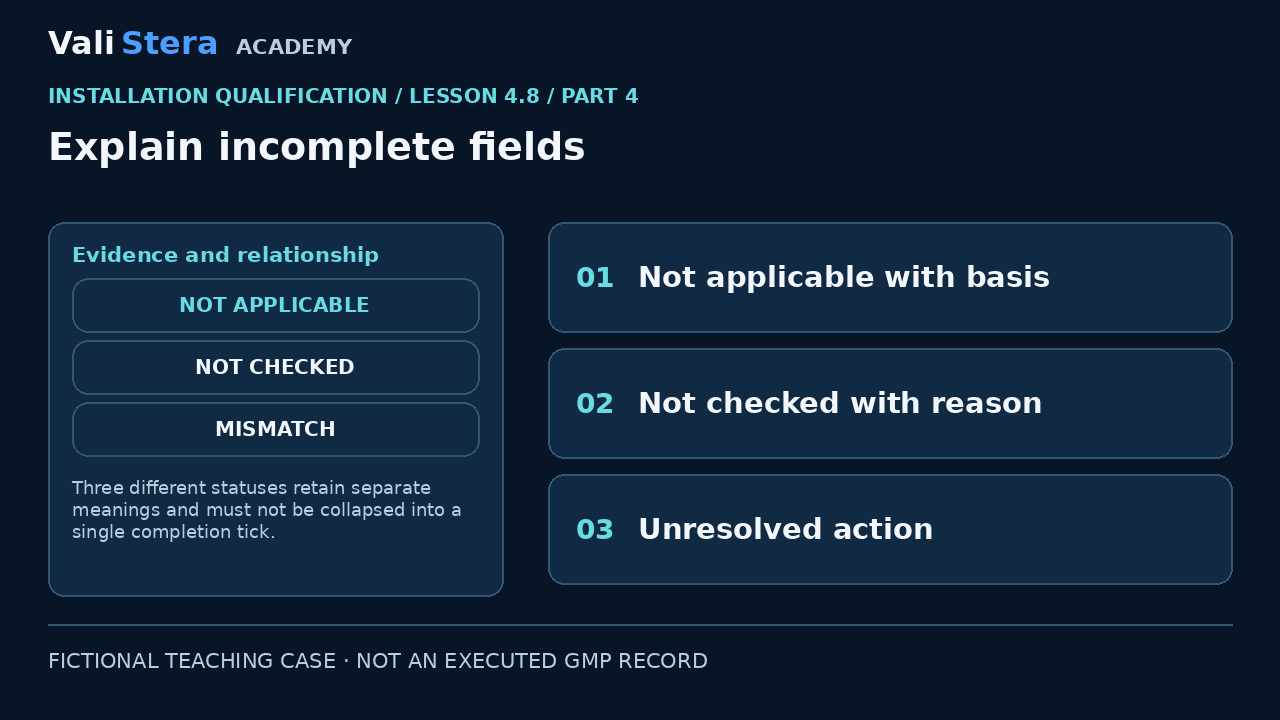
Explain incomplete fields
View Technical Explanation · Diagram 4
Lesson explanation
Not applicable, not checked and failed are different statuses. A check outside the approved system scope needs a justified not-applicable basis. An inaccessible feature is not checked. A verified mismatch is a discrepancy. Keeping these statuses distinct prevents a completed-looking form from implying that evidence exists where it does not.
Worked example
| Status | Meaning in the exercise |
|---|---|
| Matched | Observation meets stated criterion |
| Not checked | No applicable verification completed |
| Not applicable | Justified exclusion from scope |
| Mismatch | Observed result differs from criterion |
Apply it · Activity 8
Rewrite “all items OK” as an evidence-linked valve check, then explain an uninspected hidden connection. Identify where original records, photographs, printouts and raw electronic data will be retained, the responsible owner and the applicable retention schedule.
Open workbook activityCompare with model reasoning
Record actual tag/model, location, comparator revision and evidence reference with execution details. Mark the hidden connection not checked with reason and follow-up; do not call it not applicable just to complete the form. Identify the controlled original-data location, owner, retention schedule and integrity controls; do not invent a universal retention period.